

There is a familiar sight on fencing jobs that always makes me shake my head a little. A homeowner has spent good money replacing an entire garden boundary with smart new panels, solid posts and matching gravel boards, yet the gate is still the same tired old thing that barely closes. The hinges are rusty, the latch needs lifting into place and there is a gap underneath big enough for the family dog to squeeze through. It happens surprisingly often. For something that gets opened and closed almost every day, the humble garden gate rarely receives the attention it deserves.
I have always maintained that a gate should be planned alongside the fencing, not treated as an extra once the main work is finished. A properly fitted garden gate in York needs to suit the opening, the ground conditions and the way people actually use their garden. Get those details right and it should work without much fuss for years. Get them wrong and even an expensive gate can become troublesome within months.
The problem is that people tend to judge gates by appearance. They choose a style that matches the fence, decide where the handle should go and assume the rest will take care of itself.
Unfortunately, gates have a much harder life than fence panels.
A Fence Stands Still. A Gate Has to Work.
This is the first thing I explain when discussing a new garden boundary.
Most fence panels spend their lives standing in one position. They take wind pressure, rain and changes in temperature, but they are not constantly moving.
A gate is different.
Every time somebody opens it, the hinges pull against the supporting post. The weight of the gate creates leverage, and that force changes as the gate swings. Add a strong gust of wind, somebody pushing against it or a child swinging on the frame, and the strain increases.
Over time, small weaknesses become obvious.
A hinge screw loosens. The supporting post moves slightly. The gate drops a few millimetres. Eventually, the latch no longer lines up with the keep.
The homeowner starts lifting the gate to close it.
I have seen people doing this for years without realising that the problem is getting worse.
Sometimes a simple hinge adjustment solves it. Other times the entire supporting post has begun leaning, and no amount of trimming or adjusting will provide a lasting repair.
That is why the structure supporting the gate matters just as much as the gate itself.
The Gate Post Is Often the Weakest Point
One of the most common mistakes I see is fitting a substantial timber gate to an ordinary fence post without allowing for the extra load.
A fence post supports panels on either side. A gate post has to support a moving weight hanging from one edge.
The difference is significant.
A heavy closeboard gate can put considerable strain on its hinges and supporting post, particularly when it is wide.
If the post is too small, poorly anchored or set into weak ground, movement is almost inevitable.
For many domestic fencing installations, posts are commonly set around 600mm into the ground. Gate posts may need deeper or more substantial foundations, depending on the gate’s height, width, weight and exposure.
There is no single depth that suits every situation.
In York, where gardens can have clay-rich soil, old rubble or disturbed ground from previous building work, I would always want to assess the conditions before deciding how to support a gate.
A post that feels solid during a dry summer can behave differently after weeks of winter rain.
I have removed gate posts where the timber looked sound above ground but had rotted badly around the soil line. Others were perfectly healthy but had been installed with inadequate concrete.
The gate itself was not the problem.
The foundation was.
A Wider Gate Is Not Always a Better Gate
Homeowners often ask for the widest possible opening.
I understand the thinking. A wide gate makes it easier to move garden furniture, wheelie bins, lawnmowers and other bulky items.
But width brings additional weight and leverage.
A single wide timber gate can place much greater strain on its supporting post than a narrower one.
This does not mean wide gates should be avoided. It means they need to be designed properly.
For particularly large openings, a pair of gates may be more practical than one heavy leaf. In other cases, stronger posts, suitable hinges and a properly braced frame will provide the necessary support.
The intended use matters too.
If the gate only provides pedestrian access, there is little point making it unnecessarily large.
If it needs to accommodate a wheelbarrow or mobility equipment, the clear opening width becomes far more important.
I always prefer to establish what needs to pass through the opening before discussing the final dimensions.
It is surprising how often that simple question gets missed.
York’s Older Properties Bring Their Own Problems
Garden gates can be particularly awkward on older properties.
Parts of South Bank, Holgate, Bootham and other established York neighbourhoods have narrow rear passages, uneven brick openings and garden boundaries that have been altered repeatedly over the years.
An opening that appears square from a distance may be several centimetres wider at the top than the bottom.
Old brick pillars may lean slightly.
Paving may slope towards a drain.
A step or raised threshold might restrict how far the gate can open.
These details matter because a gate needs clearance to move freely.
I have seen homeowners buy standard-sized gates online, only to discover that the opening is nowhere near as regular as they assumed.
The gate might fit between the posts, but it catches the paving halfway through its swing.
Or the latch side has such a large gap that privacy and security suffer.
For awkward openings, a made-to-measure timber gate is often the sensible option. It allows the dimensions, bracing and clearances to be designed around the property.
That can be especially useful where the gate needs to sit between old brick walls that are worth retaining.
Timber Movement Is Normal, but Poor Fitting Makes It Worse
Timber changes throughout the year.
During warm, dry weather, it loses moisture and can shrink. During wetter months, it absorbs moisture and may swell.
This is normal behaviour.
It does not automatically mean the timber is defective.
The trouble begins when a gate has been fitted with insufficient clearance.
A gate that closes perfectly in July may begin catching in November as the timber takes on moisture.
If the frame has been built poorly or the boards have been fixed without allowing for natural movement, the problem can become worse.
Pressure-treated timber generally offers better protection against decay than untreated material, but treatment does not prevent seasonal movement.
I have always preferred to allow sensible clearances and use suitable fixings rather than build a gate so tightly that it only works in one set of weather conditions.
The exact gaps depend on the design, materials and installation.
Too little clearance causes sticking.
Too much creates unwanted gaps and can reduce security.
It is a balance that needs getting right during installation.
The Hinges Do More Work Than Most People Realise
Hinges are another area where cutting costs rarely makes sense.
A small, lightweight gate may work perfectly well with ordinary hinges suited to its weight.
A tall, heavy timber gate needs something more substantial.
The hinge type, length, material and fixing method should all suit the gate.
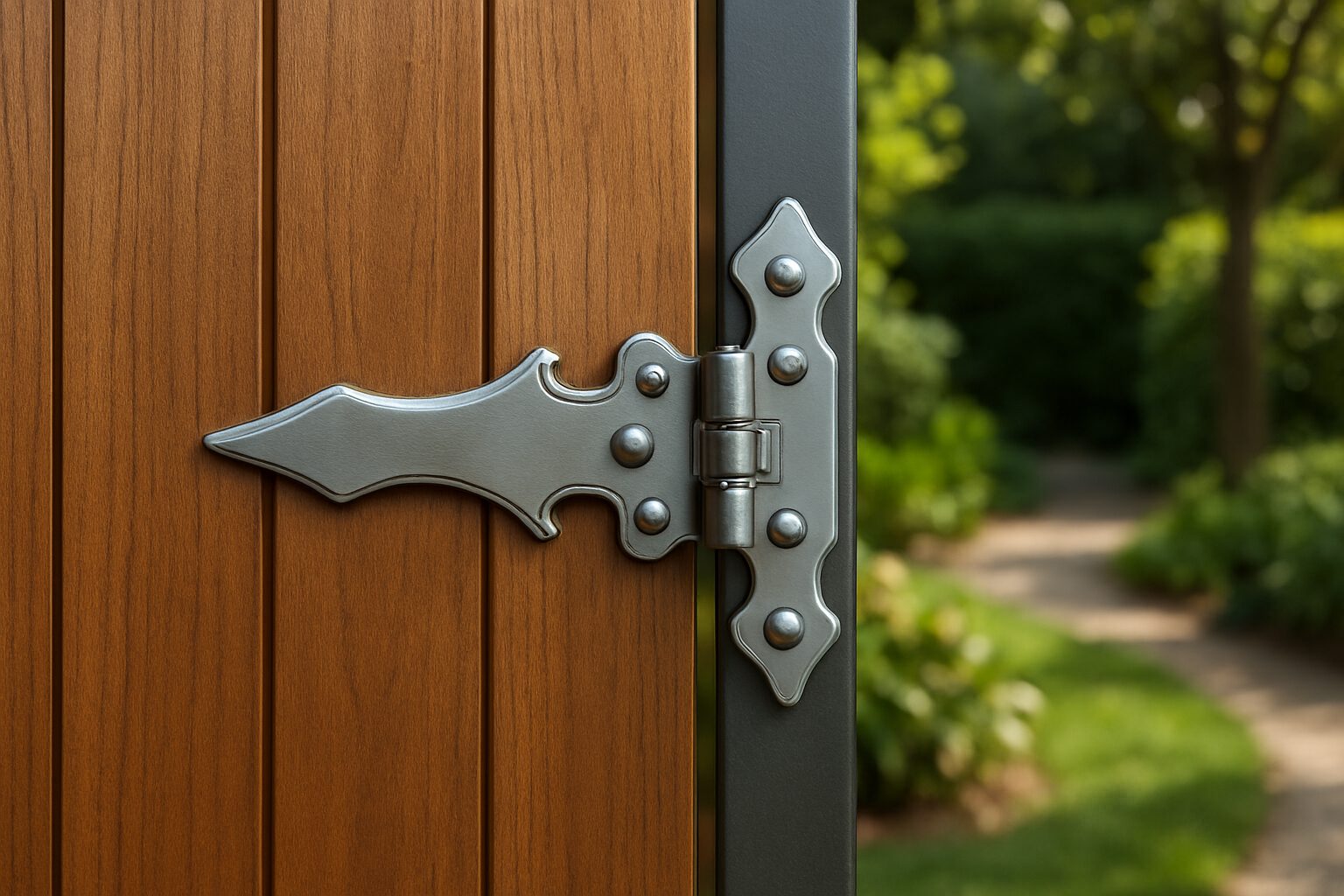
For many timber garden gates, properly sized hook and band hinges are a practical choice. They spread the load across a larger section of the frame and provide good support when fitted correctly.
But even strong hinges will struggle if they are fixed into weak timber.
I have seen gates where the hinges themselves were perfectly sound, yet the screws had pulled out because the frame had split.
That is why the construction of the gate matters.
The rails, bracing and hinge positions all contribute to its strength.
A gate should be built as a working structure, not simply as a decorative panel with hinges attached.
Good Bracing Stops a Gate From Dropping
This is one of those details that experienced fencing contractors tend to notice immediately.
A traditional timber gate needs suitable diagonal bracing to resist sagging.
On a conventional framed timber gate, a compression brace normally runs from the lower hinge side towards the upper latch side.
That arrangement helps transfer weight back towards the supporting hinges.
Get the bracing wrong and the gate can gradually lose its shape.
I have encountered gates where the diagonal timber was fitted in the wrong direction, leaving the frame poorly supported.
Others had no meaningful bracing at all.
They looked fine when first installed, but the latch side slowly dropped.
Not every gate uses the same construction method. Some modern systems rely on different frame designs or tension bracing.
The principle remains the same.
The structure needs to resist its own weight over years of regular use.
Security Starts With the Gate, Not Just the Fence
A tall, solid fence provides little benefit if the gate can be pushed open with minimal effort.
This is something homeowners sometimes overlook.
They invest in six-foot fencing for privacy and security, then fit a basic latch that can be reached over the top.
The right level of security depends on the property and how the gate is used.
A rear access gate leading to an alleyway may need a different locking arrangement from a gate between the front and back gardens.
For some properties, a suitable key-operated lock makes sense. Others may benefit from stronger bolts, reinforced frames or better hinge protection.
The position of the lock matters too.
A lock that is difficult for an adult to reach may also be awkward during an emergency.
Where a gate forms part of an escape route, the locking arrangement should allow safe exit.
I would also consider visibility.
A completely solid gate provides privacy, but it can conceal activity behind it. In some locations, a design that allows limited visibility may be preferable.
The best security arrangement depends on the actual risks rather than simply fitting the heaviest lock available.
Children and Pets Change the Design
A family garden needs to work for everyone using it.
That includes children and animals.
For households with young children, the gate should close securely and have a latch positioned appropriately for the family’s needs.
Sharp edges, exposed fixings and obvious finger-trapping points should be avoided.
The gap beneath the gate deserves attention too.
Small dogs can squeeze through surprisingly narrow spaces, especially if the ground slopes away from the opening.
I have seen gates fitted with perfectly good locks while leaving a substantial gap at the bottom.
For a determined terrier, that is an invitation.
Ground clearance needs balancing against the risk of the gate catching on paving, gravel or uneven surfaces.
If the garden slopes, a specially shaped gate or altered threshold may be needed.
There is no point fitting a gate that keeps the dog in but cannot open properly after a heavy frost.
Drainage Can Affect a Gate More Than You Expect
Standing water around gate posts is never helpful.
Timber posts exposed to persistent moisture are more vulnerable to decay, particularly around ground level.
Poor drainage can also soften the surrounding soil and allow movement.
In older York gardens, I sometimes find gates positioned at the lowest point of the boundary, where water naturally collects.
That may be convenient for access, but it creates additional challenges.
If the gate opens across paving that regularly floods, the problem should be considered before installing new timberwork.
The solution might involve improving surface drainage, adjusting the finished levels or changing the gate’s clearance.
Simply replacing a rotten post without addressing the conditions that caused the decay may lead to the same problem returning.
This is particularly relevant during autumn and winter, when prolonged wet weather can expose drainage issues that remain hidden during summer.
Matching the Gate to the Fence Is Not Always the Best Decision
People naturally want their gate to match the surrounding fencing.
Sometimes that works beautifully.
A closeboard gate alongside closeboard fencing can create a neat, consistent boundary.
A slatted gate can complement modern horizontal fencing.
But appearance should not override practical requirements.
A lightweight decorative gate might look right but offer insufficient privacy or security.
A very heavy solid gate might match the fence perfectly while placing unnecessary strain on a narrow opening.
In some gardens, a contrasting gate works better.
A framed timber gate with stronger construction can sit comfortably alongside standard fence panels without needing to copy every detail.
The same applies to materials.
Composite fencing may be an attractive low-maintenance choice, but the matching gate needs to be assessed as a complete system. Its weight, frame, hinges and fixing requirements may differ from those of a conventional timber gate.
I would rather see a slightly different gate that works properly than a perfect visual match that needs constant adjustment.
Why Cheap Gate Repairs Often Become Expensive
One of the most common requests I receive is to repair a gate that has started dropping.
Sometimes the solution is straightforward.
Tighten or replace the hinges, adjust the latch and check the frame.
But there are occasions where repeated small repairs are simply delaying the inevitable.
If the supporting post is rotten, fitting larger hinges will not solve the problem.
If the gate frame has twisted badly, trimming the bottom may only provide temporary clearance.
If the timber around the fixings has split, moving the screws a few centimetres may not provide adequate support.
I have seen gates that have been trimmed so many times that the bottom gap has become enormous.
The homeowner kept cutting away the part that was catching, while the post continued leaning.
A proper assessment of fence and gate repairs should establish whether the fault lies with the hinges, the gate itself or the supporting structure.
Repair is often worthwhile.
Repeatedly repairing the wrong part is not.
The Cost of a Gate Is Not Just the Gate
People comparing garden gate prices often focus on the cost of the timberwork.
That is understandable, but the complete installation can involve considerably more.
There may be old posts to remove, new foundations to dig, concrete to supply and waste to dispose of.
Brickwork might need attention.
The opening may require adjustment.
A lock, latch, hinges and other fittings need to be included.
Access can also affect labour costs.
Installing a gate in a clear opening with sound supporting posts is very different from replacing one between ageing brick pillars in a narrow York terrace.
For this reason, I would be cautious about quotations that provide a single price without explaining what is included.
A cheaper gate fitted to inadequate posts may cost more in repairs than a properly supported installation.
The sensible comparison is the total cost of a working gate, not merely the price of the gate leaf.
Autumn Is a Good Time to Check Gate Alignment
As we move towards winter, I would encourage homeowners to spend a few minutes checking their garden gates.
Open and close each one several times.
Does it swing freely?
Does the latch engage without lifting the gate?
Are the hinges secure?
Is the supporting post moving?
Has the gap changed since summer?
Look for soft timber around the base of the posts and signs of water collecting nearby.
Check that bolts and locks operate properly.
A little seasonal movement is normal, but sudden changes deserve attention.
If a gate begins catching after heavy rain, do not immediately start cutting timber away.
Find out whether the problem is swelling, post movement or a change in the ground.
A small adjustment may be enough. A moving post needs a different approach.
A Gate Should Be Designed Around Daily Life
This is the part of gate installation I think deserves more attention.
How does the household actually use the opening?
Does somebody take the bins through twice a week?
Do children regularly carry bicycles into the garden?
Is the gate used by delivery drivers?
Does the family have a dog that tries to escape?
Will the garden need access for landscaping equipment?
These questions influence the ideal width, opening direction, latch position and construction.
For a household with several bicycles, a narrow gate may become irritating very quickly.
For an elderly homeowner, a heavy gate with a stiff latch may be difficult to use.
For somebody with a garden office, a secure and easy-to-operate access gate may be particularly useful.
Good design is not simply about choosing the right timber.
It is about making the gate fit the people who use it.
The Details That Make a Gate Last
After years of working with fencing and gates, I have become convinced that the small details are usually the ones that determine how well an installation performs.
Properly supported posts.
Suitable foundations.
Correctly sized hinges.
A strong, well-braced frame.
Appropriate clearance.
Decent fixings.
A latch that works without forcing the gate.
Timber protected from prolonged ground contact.
None of these details is especially glamorous, and most will never attract attention once the job is complete.
That is exactly the point.
A good garden gate should not need constant attention.
You should be able to open it, close it and get on with your day.
If you are planning new fencing, think about the gate before the posts go in. Decide how wide the opening needs to be, which way it should swing and what level of security is appropriate.
It is far easier to build those requirements into the original installation than alter everything afterwards.
I have seen plenty of homeowners spend considerable money on attractive garden fencing, only to be frustrated by a gate that never quite works properly.
And I have seen modest, well-built timber gates remain perfectly serviceable for years because somebody took the time to get the basics right.
The difference is rarely the price of the timber.
It is the thought that went into the installation.
A fence defines the garden boundary. The gate is the part you have to live with every day. It deserves to be treated accordingly.
Key Takeaways
- Many homeowners neglect to replace old gates when installing new fencing, resulting in a mismatch in quality and functionality.
- Garden gates require proper planning and attention to detail during installation to ensure they function effectively over time.
- The strain on a gate’s hinges and supporting post is significantly affected by its weight, width, and movement, necessitating suitable support structures.
- Gate posts should be appropriately deep and strong based on the gate’s specifications and existing ground conditions to prevent failure over time.
- Homeowners often overlook practical usability needs when designing gate openings, leading to gates that may not accommodate larger garden items.
- Older properties in York may have irregular openings that necessitate custom-made gates to ensure proper fit and functionality.